Anchor Bolt
Bolts · foundation bolt · cast-in-place bolt · L-bolt
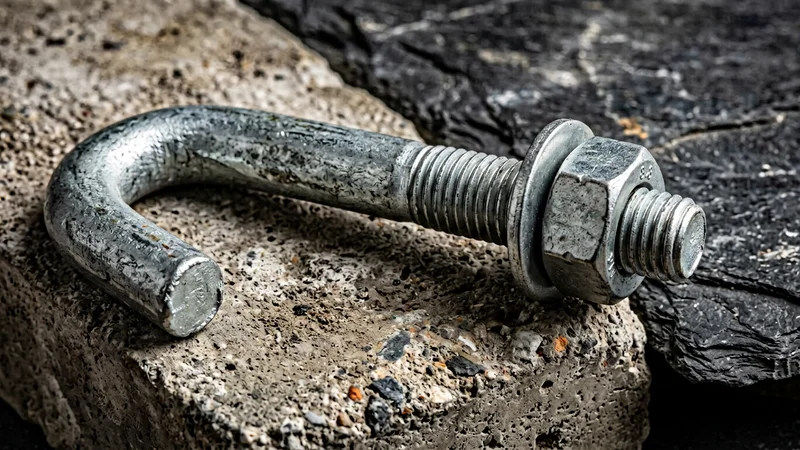
Definition: An anchor bolt is a headed, L-shaped, or straight rod cast into concrete to connect structural steel or equipment to a foundation.
Anatomy & Schematic
■ Head■ Shank■ Threads■ Point
Governing standards: ASTM F1554 · ASTM A307
Common Sizes
| Inch | Metric | Head width | Head height |
|---|---|---|---|
| 1/2-13 | M12 | — | 6 to 24 long |
| 5/8-11 | M16 | — | 8 to 36 long |
| 3/4-10 | M20 | — | 10 to 48 long |
Representative sizes. Full dimensional data lives in the standards listed below.
Grades & Strength
| Grade | Material | Tensile (psi) | Marking |
|---|---|---|---|
| Grade 36 | low carbon steel | 58,000 | F1554 36 |
| Grade 55 | medium carbon steel | 75,000 | F1554 55 |
| Grade 105 | alloy steel, Q&T | 125,000 | F1554 105 |
Materials
- Zinc-plated steel
- Hot-dip galvanized steel
- Stainless steel
Pros & Cons
Pros
- Very high pull-out capacity
- Standard in structural work
- Inexpensive for the capacity
Cons
- Must be positioned before the pour
- Templates required for accuracy
- Cannot be adjusted after curing
Typical Uses
- Column base plates
- Equipment foundations
- Light poles
- Bearing plates
Alternatives & Related
- Wedge Anchor — Post-installed into existing concrete
- Chemical Anchor — Epoxy-bonded rod where you cannot cast in place
- J-Bolt — Hooked embedment for lighter duty
Where to Buy
Affiliate links — we may earn a commission at no cost to you.
FAQ
Anchor bolt vs J-bolt?
An anchor bolt has a forged head or L-bend for deep embedment and heavier loads; a J-bolt is a lighter hooked rod for sills and equipment.
What grade anchor bolt do I need?
F1554 Grade 36 is the general-purpose default; Grade 55 is stronger, and Grade 105 is the high-strength, weldable choice for heavy structures.