Self-Tapping Screw
Screws · sheet metal screw · thread-forming screw · thread-cutting screw
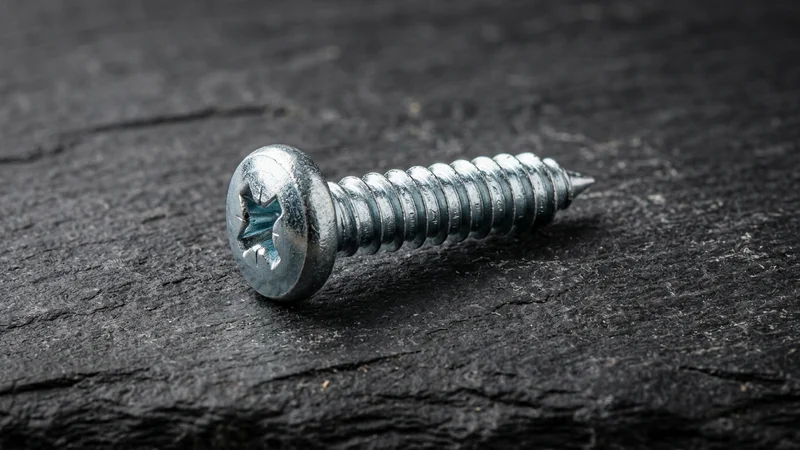
Definition: A self-tapping screw forms or cuts its own mating thread as it is driven into a pre-drilled or pre-punched hole in metal or plastic.
Anatomy & Schematic
■ Head■ Shank■ Threads■ Point
Governing standards: ASME B18.6.4
Common Sizes
| Inch | Metric | Head width | Head height |
|---|---|---|---|
| #6 x 1/2 | M3.5 x 13 | 9/32 | 7/64 |
| #8 x 3/4 | M4.2 x 19 | 5/16 | 1/8 |
| #10 x 1 | M4.8 x 25 | 3/8 | 5/32 |
Representative sizes. Full dimensional data lives in the standards listed below.
Grades & Strength
| Grade | Material | Tensile (psi) | Marking |
|---|---|---|---|
| Standard | case-hardened steel | — | None |
| Stainless | 410 / 304 stainless | — | None |
Materials
- Zinc-plated case-hardened steel
- Stainless steel
- Brass
Pros & Cons
Pros
- No tap required — saves a step
- Strong holding in thin sheet metal
- Available in many head and drive styles
Cons
- Needs a correctly sized pre-drilled hole
- Can strip if over-tightened in thin material
- Limited reuse (threads wear each cycle)
Typical Uses
- Sheet metal assembly
- Plastic enclosures
- Ductwork
- Automotive bodywork
Alternatives & Related
- Self-Drilling Screw — Skips the pre-drilling step entirely
- Machine Screw — For pre-tapped holes
Where to Buy
Affiliate links — we may earn a commission at no cost to you.
FAQ
Do self-tapping screws need a pilot hole?
Yes — a hole sized to the screw root diameter. Self-drilling screws are the ones that make their own hole.
Can self-tapping screws be used in wood?
Not recommended. Wood screws have deeper, sharper threads for fiber grip; sheet-metal threads are too fine.