Tooth Washer vs. Split Washer
Two old-school answers to vibration loosening: teeth that bite the surface, or a split ring that digs in like a spring. Both are cheap insurance — neither beats a lock nut where vibration is severe.
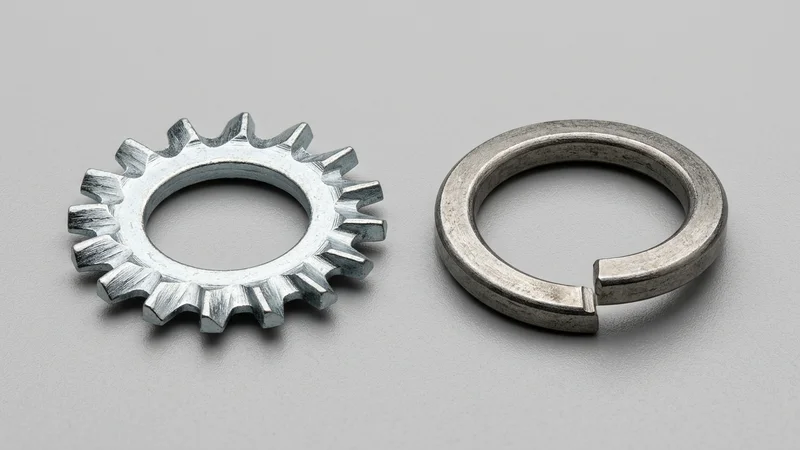
| Feature | Tooth Washer | Split Washer |
|---|---|---|
| How it locks | Teeth bite into the nut and surface | Split ends dig in under load |
| Best surface | Soft to medium metals | Soft to medium metals |
| Reusable | No — teeth flatten | Marginally — spring weakens |
| Vibration resistance | Moderate | Low to moderate |
| Finish damage | Visible teeth marks | Circular score marks |
| Extra duty | Doubles as a grounding washer (electrical) | None |
| Best for | Grounding lugs, light machinery | Cheap general-purpose insurance |
Verdict
Use a tooth washer where bite matters — grounding lugs and light machinery. Use a split washer for cheap general-purpose insurance. For real vibration, skip both and use a prevailing-torque nut or threadlocker.
Shop This Comparison
- Tooth lock washer assortment — internal + external tooth
- Split lock washer assortment — zinc-plated, multi-size
Affiliate links — we may earn a commission at no cost to you.
Also in the toolbox
- Threadlocker (Loctite Blue 242) — when washers are not enough
FAQ
Do lock washers actually work?
Modestly. Studies (including widely-cited fastener research) show split washers add little holding power on hard surfaces and can even loosen faster once flattened. They work best as cheap insurance on soft joints — for critical vibration, use prevailing-torque nuts or threadlocker.
What is the difference between internal and external tooth washers?
Internal-tooth washers have teeth inside the ring — neater, for small screw heads. External-tooth washers have teeth outside — more bite, for larger bolts and grounding. Same principle, different footprint.