Wedge Anchor vs. Sleeve Anchor
Both are mechanical expansion anchors for masonry, but they grip at opposite ends of the hole: a wedge anchor jams a clip at the bottom of the embedment for maximum bite in solid concrete, while a sleeve anchor squeezes its full-length sleeve outward for a gentler grip that brick and block can survive. Strong base, wedge; fragile base, sleeve.
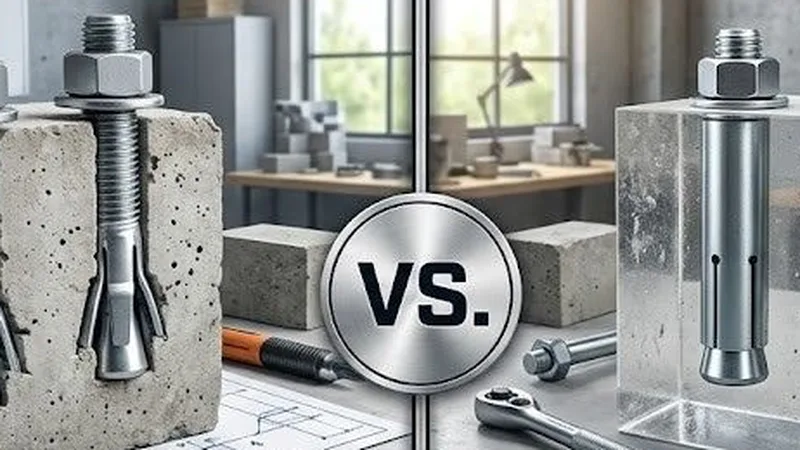
| Feature | Wedge Anchor | Sleeve Anchor |
|---|---|---|
| How it grips | Clip wedges at the hole bottom as you torque | Sleeve swells along its full length |
| Grip zone | Concentrated at the bottom — maximum bite | Spread out — lower peak stress |
| Solid concrete | Excellent — the strongest mechanical anchor | Good — adequate for medium loads |
| Brick and block | Risky — concentrated force can crack units | The right choice — gentle, distributed grip |
| Typical sizes | 1/4 in to 1-1/4 in, deep embedment | 1/4 in to 3/4 in, moderate embedment |
| Removability | Permanent — cut the stud flush to abandon | Semi — back out the bolt, sleeve stays |
| Vibration / seismic | Excellent — rated and seismic-listed options | Fair — not for critical dynamic loads |
| Best for | Racking, machinery, and structural steel on concrete | Handrails, shutters, and fixtures on brick or block |
Verdict
Shop This Comparison
- Wedge anchor assortment (zinc) — the solid-concrete side
- Sleeve anchor assortment — the brick-and-block side
Affiliate links — we may earn a commission at no cost to you.
Also in the toolbox
- Rotary hammer drill (SDS-plus) — bores true anchor holes
- Torque wrench — sets expansion anchors to spec
FAQ
What is the difference between a wedge anchor and a sleeve anchor?
A wedge anchor expands a clip at the bottom of the hole for maximum holding power in solid concrete; a sleeve anchor expands a sleeve along its full length for a gentler grip suited to brick, block, and softer masonry. Wedge for strength, sleeve for fragile base material.
How does a wedge anchor work?
You drill a hole, tap the anchor in, and tighten the nut — pulling the stud up draws the tapered end through an expansion clip, jamming it against the hole wall. Torque to the specified value and the clip bites permanently; that is why wedge anchors cannot be backed out and reused.
How do sleeve anchors work?
Tightening the bolt draws a tapered nut up into the slotted sleeve, swelling it outward against the full length of the hole. The distributed pressure grips without the concentrated bursting force of a wedge, which is exactly why sleeves survive in brick and block.
Can I use a wedge anchor in brick or block?
Not safely in most cases — the concentrated expansion at the hole bottom can split brick faces and crack hollow block webs. Sleeve anchors, designed for exactly these materials, cost about the same and will not destroy the wall. Save wedges for solid concrete.