Best Fasteners for Deck Builders
A deck is three fastening jobs in one: structural framing and ledgers that carry the load, decking boards that take the weather, and railings and stairs that take the abuse. Pros reach for code-listed structural screws, coated star-drive deck screws, hidden clip systems for composite, and real joist-hanger nails — never screws — in hangers.
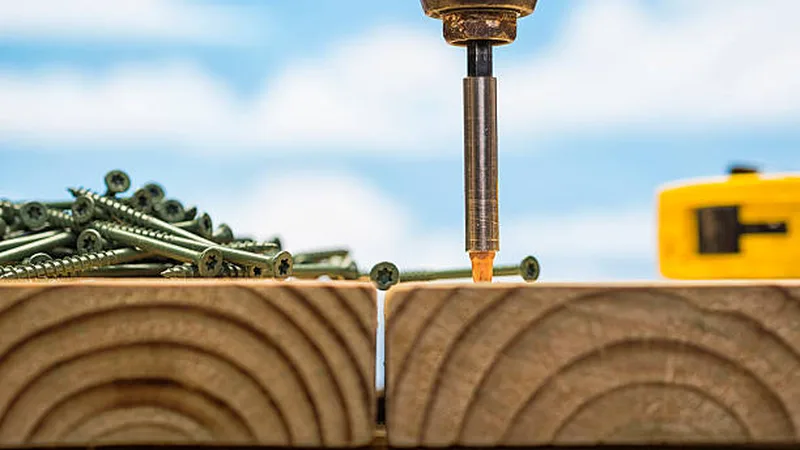
What to Look For
- Code-listed structural screws or 1/2 in through-bolts for ledgers — the connection inspectors actually check.
- Coated, star-drive deck screws for face-screwing — corrosion-rated for treated lumber, heads that do not strip.
- Hidden clip systems for grooved composite and PVC — the fastener-free surface clients pay a premium for.
- Joist-hanger nails (never screws) in every hanger — nails bend under load where screws snap.
- Stainless steel within sight of saltwater or pools — coated carbon steel everywhere else.
Top Picks
1. GRK RSS structural screws, assorted lengths Best overall
Ledger, posts, beams, and stair stringers from one box — code-listed, self-tapping, and strong enough to replace lags in most residential connections.
Check price on Amazon →2. Trex Hideaway hidden fasteners, 500 sq ft bucket Best for composite decking
The default hidden system for grooved boards — consistent gapping, stainless screws included, and a clean surface with zero visible fasteners.
Check price on Amazon →3. Star-drive coated deck screws, bulk 5 lb box Best for face-screwing wood
Pressure-treated and cedar decks still get face-screwed — coated star-drive screws rated for ACQ lumber drive clean and hold for decades.
Check price on Amazon →4. Simpson Strong-Tie joist-hanger nails, 1-1/2 in Best for hangers
Short, fat, and code-listed for every hanger in the catalog. The only fastener that belongs in a joist hanger.
Check price on Amazon →What to Avoid
Avoid
- Drywall or interior screws anywhere outside — they rust, stain, and snap within a season or two.
- Screws in joist hangers and post bases — connectors are engineered and tested with nails.
- Phillips-drive deck screws — they strip halfway through the first board; star drive only.
- Plain steel with treated lumber — the copper treatment corrodes uncoated fasteners fast.
Also in the toolbox
- 20V impact driver kit — drives thousands of deck screws per charge
- Hidden-fastener installation tool — consistent gaps with zero measuring
- Speed square — layout, stair math, and a saw guide in one
FAQ
Should you use screws or nails for deck framing?
Code-listed structural screws or nails per the framing schedule — both are accepted, but ordinary deck screws are not structural. Ledgers specifically need structural screws, through-bolts, or code-listed ledger fasteners.
What screws are best for composite decking?
The hidden clip system matched to the board brand (Trex Hideaway, TimberTech CONCEALoc, TigerClaw) for grooved boards — or composite-rated face screws with color-matched heads for square-edge boards and fascia.
Why can you not use screws in joist hangers?
Hangers are engineered around nails that bend and absorb load; standard screws are brittle in shear and snap. Connector manufacturers only list screws they specifically test (like structural connector screws) — when in doubt, use the specified hanger nails.
How far apart should deck screws be?
Two screws per board at every joist, set about 3/4 in from each board edge. Hidden clips space themselves — one clip per joist per board gap.
Keep Reading
- Deck Screw
- Structural Screw
- Lag Bolt
- Framing Nail
- Best Screws for Deck Boards
- Best Screws for Composite Decking
Affiliate links — we may earn a commission at no cost to you.