What Size Screws for Drywall (1/2 vs 5/8)
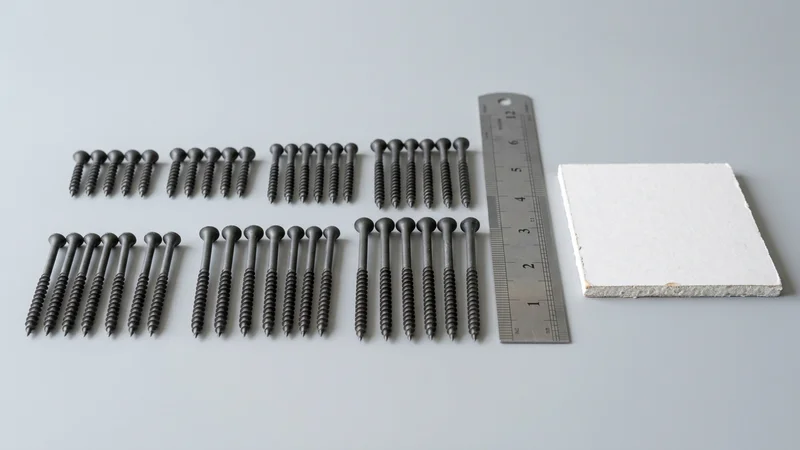
Drywall sizing is the simplest in framing: #6 screws at 1-1/4 in for 1/2-in board, 1-5/8 in for 5/8-in board — coarse thread for wood studs, fine thread for steel. The rule behind it: bite at least 5/8 in into the framing past the board. Ceilings step up one size for gravity.
What to Look For
- 1/2-in walls: #6 x 1-1/4-in coarse — 3/4-in stud bite.
- 5/8-in walls: #6 x 1-5/8-in coarse.
- Ceilings: step up one length — 1-5/8-in for 1/2-in board.
- Wood studs take coarse (W-type); steel studs take fine (S-type).
- Minimum 5/8-in framing bite — the code rule.
Top Picks
1. Grip-Rite #6 x 1-1/4-in coarse drywall screws (bulk) Best overall
The 1/2-in drywall screw — black phosphate, bugle head, contractor boxes.
Check price on Amazon →2. Grip-Rite #6 x 1-5/8-in coarse drywall screws For 5/8-in and ceilings
Steps up for 5/8-in board and all ceilings — extra bite against gravity.
Check price on Amazon →3. Hillman #6 x 1-1/4-in fine-thread drywall screws For steel studs
S-type fine threads for 25- and 20-gauge metal framing.
Check price on Amazon →What to Avoid
Avoid
- Wood screws — heads tear paper facing instead of dimpling it.
- 1-in screws in 1/2-in board — barely 1/2-in bite, pops follow.
- Coarse thread in steel studs — strips and spins.
Also in the toolbox
- Drywall screw setter bit set — dimples every head perfectly — no tears, no pops
- Chalk line reel — marks stud lines across full sheets
FAQ
How many screws per sheet of drywall?
A 4x8 sheet on 16-in stud centers takes about 32 screws: every 12 in in the field, every 8 in on edges (some codes want 7 in on ceilings). Mark stud lines with chalk first — missed studs are wasted screws.
Why are my drywall screws popping?
Three causes: screws too short (under 5/8-in bite), heads driven past the paper (torn paper holds nothing), or lumber shrinkage pulling the board. Fix with longer screws beside the pops — 1-5/8-in where 1-1/4-in failed.
Coarse or fine thread drywall screws?
Coarse (W-type) for wood studs — aggressive threads bite softwood fast. Fine (S-type) for steel studs — fine threads grip thin gauge without stripping. Using coarse in steel is the classic metal-stud mistake.
Keep Reading
Affiliate links — we may earn a commission at no cost to you.