Flange Nut
Nuts · serrated flange nut · flanged hex nut · flange lock nut
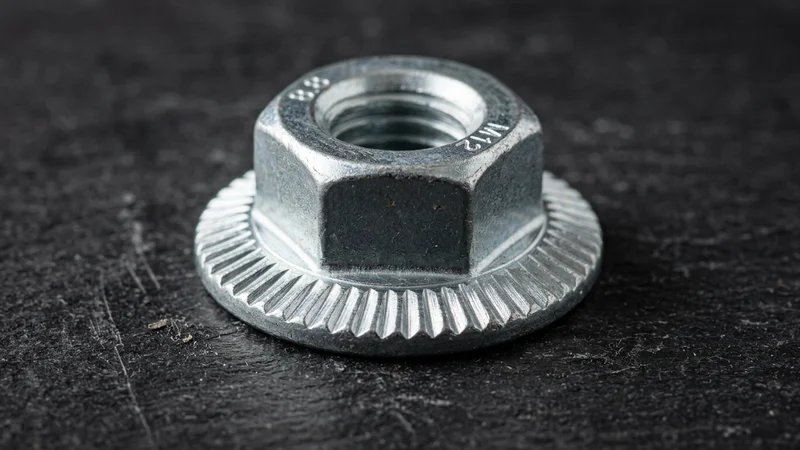
Definition: A flange nut is a hex nut with a built-in washer-like flange at its base that spreads the load and resists loosening.
Anatomy & Schematic
■ Body■ Internal thread
Governing standards: ASME B18.2.2 · DIN 6923
Common Sizes
| Inch | Metric | Head width | Head height |
|---|---|---|---|
| 1/4-20 | M6 x 1.0 | 7/16 | 19/64 |
| 3/8-16 | M10 x 1.5 | 9/16 | 15/32 |
| 1/2-13 | M12 x 1.75 | 3/4 | 19/32 |
Representative sizes. Full dimensional data lives in the standards listed below.
Grades & Strength
| Grade | Material | Tensile (psi) | Marking |
|---|---|---|---|
| Grade 5 | medium carbon steel, Q&T | 120,000 | 3 radial lines |
| Grade 8 | alloy steel, Q&T | 150,000 | 6 radial lines |
Materials
- Zinc-plated steel
- Stainless steel
- Hot-dip galvanized steel
Pros & Cons
Pros
- Washer and nut in one — saves a part
- Larger bearing area than a plain hex nut
- Serrated versions resist vibration
Cons
- Needs more wrench clearance than a plain nut
- Slightly more expensive
- Flange can mark soft or painted surfaces
Typical Uses
- Automotive and engine assembly
- Machinery and equipment
- Applications where a washer would be awkward to place
Alternatives & Related
Where to Buy
Affiliate links — we may earn a commission at no cost to you.
FAQ
What is a flange nut used for?
It combines a nut and washer, so it is used where load spreading matters and a separate washer is inconvenient — automotive, machinery, and equipment assembly.
Serrated vs non-serrated flange nut?
Serrated flanges bite into the surface to resist loosening; non-serrated flanges are gentler on painted or plated surfaces.