T-Nut
Nuts · tee nut · blind nut · pronged nut
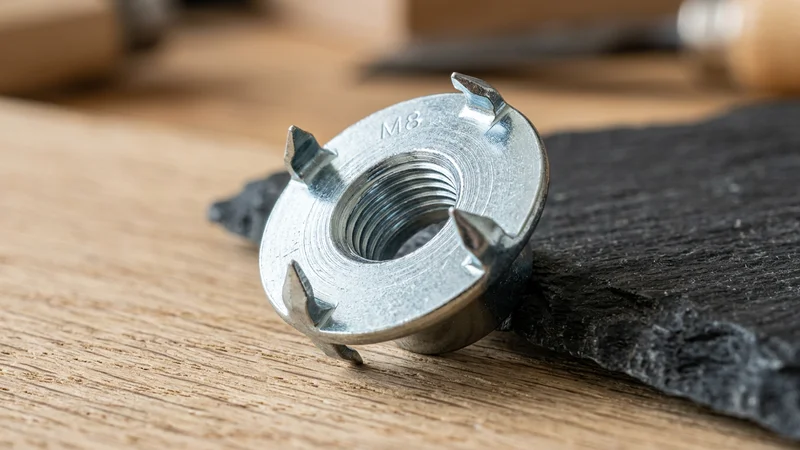
Definition: A T-nut is a nut with a pronged flange that embeds into wood or composite, providing a machine thread that receives a bolt from the other side.
Anatomy & Schematic
■ Body■ Internal thread
Governing standards: Manufacturer specified (no universal standard)
Common Sizes
| Inch | Metric | Head width | Head height |
|---|---|---|---|
| 1/4-20 | M6 | 5/16 barrel | for 5/8+ wood |
| 5/16-18 | M8 | 3/8 barrel | for 3/4+ wood |
| 3/8-16 | M10 | 7/16 barrel | for 3/4+ wood |
Representative sizes. Full dimensional data lives in the standards listed below.
Grades & Strength
| Grade | Material | Tensile (psi) | Marking |
|---|---|---|---|
| Zinc steel | carbon steel, zinc-plated | — | None |
| Stainless | 304 stainless | — | None |
Materials
- Zinc-plated steel
- Stainless steel
Pros & Cons
Pros
- Creates a strong machine thread in wood
- Holds from one side only
- Reusable thread
Cons
- Needs an exact-size drilled hole
- Prongs split thin or brittle wood
- Pulls through if over-tightened
Typical Uses
- Wood furniture and workbenches
- Jigs and fixtures
- Bolting into plywood and MDF
- Knobs and accessories
Alternatives & Related
- Rivet Nut — Threads in thin sheet metal instead of wood
- Wing Nut — Tool-free tightening on the nut side
Where to Buy
Affiliate links — we may earn a commission at no cost to you.
FAQ
How do you install a T-nut?
Drill a hole matching the barrel, press or hammer the flange flush on the back face, then drive a bolt through from the front to seat it fully.
T-nut vs threaded insert?
A T-nut has a pronged flange that grips the back face of wood; a threaded insert threads into a hole like a screw. T-nuts are stronger in wood; inserts fit thinner material.