Best Nails for Framing
Framing nails are sized by penny (d) and chosen by gun: 16d nails for walls and joists, ring-shank for sheathing and subfloor, hot-dip galvanized or stainless for treated lumber. Match the nail to the nailing schedule — diameter matters as much as length.
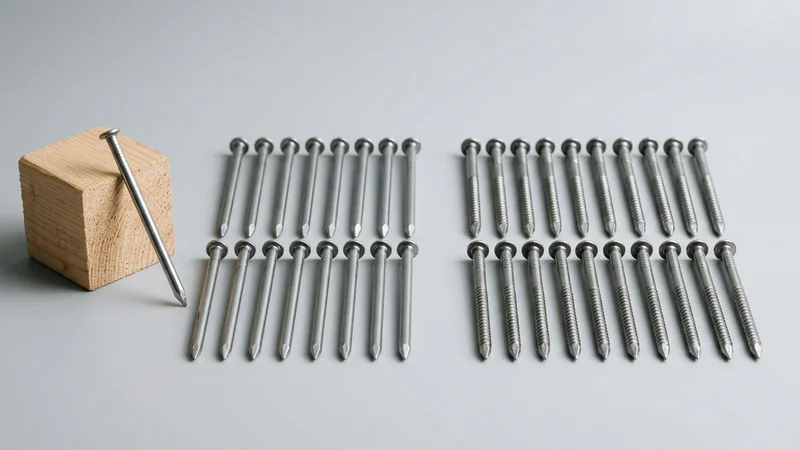
What to Look For
- 16d for walls: 3-1/2 in common or 3-1/4 in sinker, per the nailing schedule.
- Ring-shank for sheathing and subfloor — pull-out resistance where it counts.
- Collation must match the gun: 21° plastic vs 30–34° paper are not interchangeable.
- HDG or stainless for treated lumber; brights are fine (and cheaper) indoors.
- Full round heads for code — clipped heads are restricted in many jurisdictions.
Top Picks
1. Grip-Rite 16d sinker nails (3-1/4 in x .131) Best overall
Vinyl-coated sinkers drive easy, hold fast, and cost less than commons — the wall-framing default in bulk boxes.
Check price on Amazon →2. Paslode 3-1/4 in x .131 ring-shank framing nails Best for nail guns
Ring shank plus full round head in 30° paper collation — code-friendly holding power for nail guns.
Check price on Amazon →3. Maze hot-dip galvanized ring-shank nails For treated lumber
HDG coating rated for ACQ lumber with ring-shank grip — the outdoor and treated-wood pick.
Check price on Amazon →What to Avoid
Avoid
- Bright nails in treated lumber — the copper treatment eats plain steel.
- Clipped-head nails where code requires full round heads.
- Drywall screws for framing — brittle, with no shear rating for structural joints.
Also in the toolbox
- 21-degree framing nailer — frames a wall in minutes, not hours
- Estwing 16 oz framing hammer — for the nails the gun cannot reach
FAQ
What is the difference between sinker and common nails?
Sinkers are slightly smaller in diameter than commons of the same penny size (a 16d sinker is 3-1/4 in x .131 vs a 16d common at 3-1/2 in x .162), usually vinyl-coated to drive easier. Sinkers are the modern framing default; commons are the old-school full-size nail.
Can you frame with screws instead of nails?
Only with code-listed structural screws — and even then, nails rule framing because they bend under load instead of snapping. Drywall and deck screws have no shear rating for structural joints and must never carry a frame.
What do the degrees mean on framing nails?
The collation angle of the nail strip, which must match your nailer’s magazine: 21° plastic-collated and 30–34° paper-collated are the two standards. Buy the angle your gun takes — they are not interchangeable.
Keep Reading
Affiliate links — we may earn a commission at no cost to you.