Hex Bolt vs. Carriage Bolt
Both join parts with a nut, but they tighten from opposite ends: a hex bolt takes a wrench on its six-sided head, while a carriage bolt offers a smooth tamper-proof dome and a square neck that locks into wood so you tighten from the nut side only. Metal assembly points to hex; exposed wood connections point to carriage.
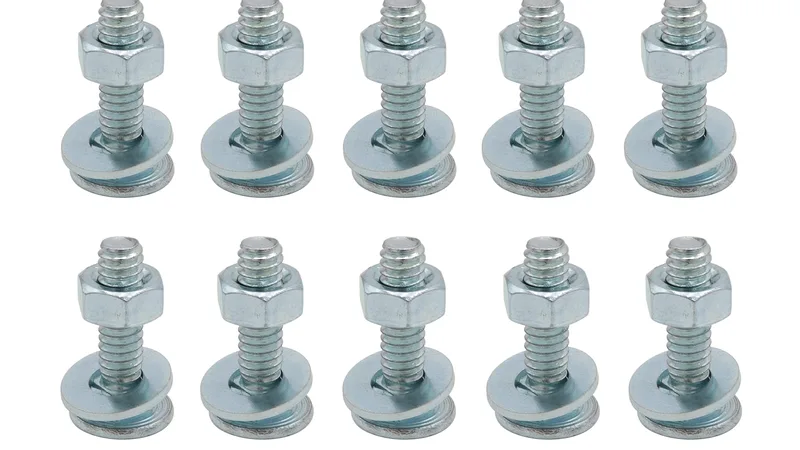
| Feature | Hex Bolt | Carriage Bolt |
|---|---|---|
| Head style | Six-sided — wrench flats all around | Smooth dome — nothing to grip |
| Tightened from | Head side, nut side, or both | Nut side only |
| Anti-turn feature | None — the wrench holds the head | Square neck seats into wood |
| Strength grades | Grade 2 through Grade 8 and metric 12.9 | Usually Grade A307 or Grade 5 |
| In metal | Native territory — full clamp, any grade | Needs a square or oversized hole to seat |
| In wood | Head can crush fibers without a washer | Dome and washer spread load gently |
| Tamper resistance | Low — any wrench fits the head | High — smooth dome defeats casual tools |
| Best for | Machinery, steel, engines, general assembly | Decks, fences, furniture, exposed woodwork |
Verdict
Shop This Comparison
- Hex bolt, nut and washer kit (Grade 5) — the assembly side
- Carriage bolt, nut and washer kit — the woodwork side
Affiliate links — we may earn a commission at no cost to you.
Also in the toolbox
- Combination wrench set (SAE) — fits hex heads and nuts
- Brad-point drill bit set — clean holes that seat square necks
FAQ
What is the difference between a hex bolt and a carriage bolt?
A hex bolt has a six-sided head you tighten with a wrench and comes in high strength grades for machinery and steel. A carriage bolt has a smooth dome head with a square neck that locks into wood, so you tighten it from the nut side only — ideal for exposed wood connections.
How does a carriage bolt work?
You drill a round hole, tap the bolt through, and the square neck under the dome bites into the wood fibers as you tighten the nut — locking the bolt against turning. That is the whole trick: the wood itself becomes the second wrench.
How do you measure a carriage bolt?
Length is measured from under the dome head to the tip (the head height is not counted), and diameter across the smooth shank. A 3/8 × 4 in carriage bolt has a 3/8 in shank and 4 in of length under the head — order one size longer when in doubt, since the nut needs full thread engagement.
Can I use a carriage bolt in metal?
Yes, with a square-hole washer or a punched square hole so the neck has something to lock into — in a plain round hole the bolt just spins. For most metal-to-metal joints a hex bolt is simpler and stronger; save carriage bolts for wood, or for metal brackets bolted through wood posts.