Lag Bolt vs. Carriage Bolt
Both are wood-construction staples, but they grip from opposite directions: a lag bolt threads into the wood itself and holds by withdrawal resistance, while a carriage bolt passes clean through and clamps the stack with a nut and washer. One-side access points to the lag; a clean through-connection with a smooth head points to the carriage bolt.
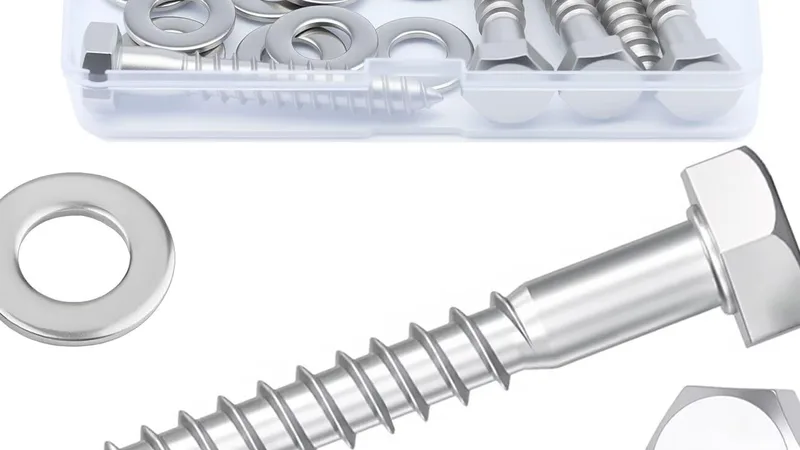
| Feature | Lag Bolt | Carriage Bolt |
|---|---|---|
| How it holds | Coarse threads bite into wood fibers | Nut and washer clamp the full stack |
| Access needed | One side only | Both sides — to place the nut |
| Exposed head | Hex head stands proud, wrench-turned | Smooth dome — snag-free and tamper-resistant |
| Anti-turn | Wrench on the head while driving | Square neck seats into the wood, one-wrench install |
| Strength limit | Thread withdrawal in the wood | Bearing and shear — usually the stronger joint |
| Re-tightenable | Re-drives, but each cycle loosens the hole | Yes — snug the nut like new as wood seasons |
| Corrosion / outdoor | HDG or stainless for treated lumber | HDG or stainless, same rule |
| Best for | Ledgers, posts, and heavy hangers on framing | Decks, fences, gates, and exposed through-connections |
Verdict
Shop This Comparison
- Lag bolt assortment (HDG) — the one-side-access side
- Carriage bolt, nut and washer kit — the through-bolt side
Affiliate links — we may earn a commission at no cost to you.
Also in the toolbox
- Brad-point drill bit set — true pilots and clearance holes
- Deep socket set (SAE) — drives lags, torques nuts
FAQ
Which is stronger, a lag bolt or a carriage bolt?
A carriage bolt in a proper through-connection, all else equal — it clamps the full stack with a nut instead of depending on thread bite in wood fibers. A lag bolt’s strength lives and dies by pilot-hole size and wood species; a carriage bolt barely notices either.
When should I use carriage bolts?
For through-connections in decks, fences, gates, raised beds, and play structures — anywhere you can reach the far side to place a nut and want a smooth, snag-free head on the visible face. The square neck locks into the wood so one wrench on the nut does the whole job.
How much weight can a carriage bolt hold?
A single 1/2 in carriage bolt through Douglas fir framing carries roughly 1,000–1,500 lb in shear depending on the connection geometry — but the wood usually governs, not the bolt. For rated connections like deck ledgers, follow the span tables and never trust a single-bolt number from the internet over your local code.
Can I replace a carriage bolt with a lag bolt?
Only where access truly forces it. Swapping a through-bolted carriage connection for lags trades clamp load for thread grip and gives up re-tightening as the wood seasons. Where the plans call for through bolts — ledgers, beams, rail posts — keep the through bolts.