Lag Bolt vs. Through Bolt
Both bolt heavy wood joints, but they hold differently: a lag bolt threads into the wood itself, while a through bolt passes through and clamps with a nut. Access decides — strength follows.
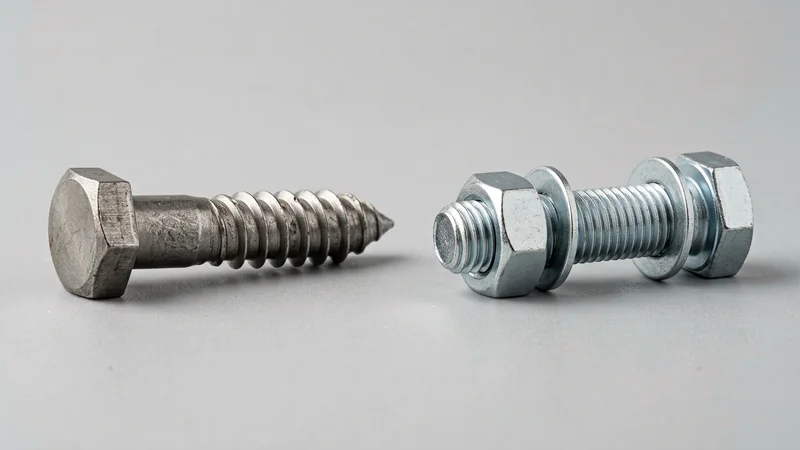
| Feature | Lag Bolt | Through Bolt |
|---|---|---|
| How it holds | Coarse threads grip the wood | Nut and washers clamp the stack |
| Needs far-side access | No | Yes |
| Relative strength | Strong | Strongest — full clamp plus shear |
| Re-tightenable | Re-drives, but loosens the hole | Yes — re-tightens like new |
| Installation | Pilot hole plus wrench | Clearance hole plus two wrenches |
| Best for | One-side access: posts, ledgers into framing | Beams, ledgers, critical joints with access |
Verdict
Lag when you can only reach one side. Through-bolt every critical joint you can reach through — the clamp of a nut beats threads in wood every time.
Shop This Comparison
- Lag bolt assortment (HDG) — the one-side-access side
- Hex bolt, nut and washer kit — the through-bolt side
Affiliate links — we may earn a commission at no cost to you.
Also in the toolbox
- Deep socket set (SAE and metric) — seats lags and torques nuts
FAQ
Which is stronger, a lag bolt or a through bolt?
A through bolt, all else equal — it clamps the full stack with a nut instead of relying on thread grip in wood fibers. A lag bolt in a stripped or oversized pilot hole is dramatically weaker; a through bolt does not care about the hole.
Can I replace a through bolt with a lag bolt?
Only where the plans allow it. Through bolts are specified for critical joints (ledgers, beams) precisely because they cannot pull out. Downgrading to a lag where a through bolt is specified needs an engineer’s sign-off, not a guess.