Grooved Pin vs. Dowel Pin
Both are straight pins pressed into drilled holes, but they solve opposite problems: a grooved pin locks itself in place with raised ribs that bite the hole wall, while a dowel pin locates parts with a precision-ground diameter and a controlled press fit. Choose retention or choose accuracy — one pin cannot give you both.
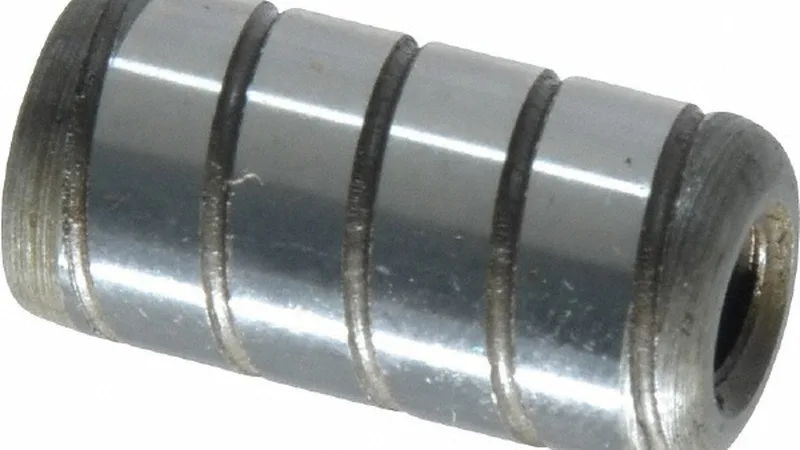
| Feature | Grooved Pin | Dowel Pin |
|---|---|---|
| How it stays put | Three pressed grooves displace metal into the hole wall — self-retaining | Interference fit between precision pin and reamed hole |
| Hole preparation | Plain drilled hole, standard tolerance | Reamed hole held to a tight tolerance |
| Diameter accuracy | Moderate — groove height varies by design | Excellent — ground to ±0.0001 in typical |
| Location repeatability | Fair — fine for hinges and pivots | Excellent — the standard for jigs and fixtures |
| Holding power | High push-out resistance for the hole size | Moderate — sized for location, not retention |
| Reuse after removal | Not recommended — grooves chew the hole on the way out | Yes, if hole and pin still gauge correctly |
| Groove / type options | Full-length, half-length, center, and spiral groove styles | Standard, oversize, and undersize classes for fit tuning |
| Best for | Hinges, latches, shear pins, and fast permanent assembly | Dowel-located tooling, gear hubs, and precision alignment |
Verdict
Shop This Comparison
- Grooved pin assortment (steel) — the self-retaining side
- Dowel pin assortment (alloy steel) — the precision side
Affiliate links — we may earn a commission at no cost to you.
Also in the toolbox
- Chuck reamer set — cuts true dowel holes
- Pin punch set — drives either pin out cleanly
FAQ
What is a grooved pin used for?
Hinges, latches, levers, and shear-pin duty — anywhere a pin must stay in a plain drilled hole without a clip, nut, or press fit. The three raised grooves bite into the hole wall during installation and resist push-out from vibration and cycling.
Can I use a grooved pin instead of a dowel pin?
Only if location accuracy does not matter. A grooved pin cannot repeat a precision location because its effective diameter varies with the grooves. For jigs, fixtures, and parts that must realign after disassembly, a reamed hole plus a ground dowel pin is still the correct answer.
Do grooved pins need a reamed hole?
No — that is their main selling point. Grooved pins are designed for ordinary drilled holes; the grooves take up the clearance and lock the pin in place. Reaming the hole removes the material the grooves need to bite and actually weakens retention.
What are standard dowel pin sizes?
Fractional diameters from 1/16 in up to 1 in, in standard lengths per ASME B18.8.2, plus a full metric range. Oversize (+0.001 in) and undersize classes let you tune the press fit to the hole you actually drilled.